By Philip Sherburne – Published in Christoph Cox and Daniel Warner, Audio Culture: Readings In Modern Music, 2004
On the one hand, there’s the stripped-down lucidity of Daniel Bell’s work as DBX, in which he crafted tracks so deliriously spare as to be almost physically disorienting – with nothing but the barest of percussion lines and an eerie, disembodied voice, it becomes difficult to orient oneself in space or in time. (Not insignificantly, Richie Hawtin’s third album as Plastikman, 1998’s Consumed, which built upon Bell’s ultra-minimal foundation, derived from Hawtin’s experience of utter darkness in Canada’s northern wilderness.) On the other hand, the polyrhythmic chaos of a track like Robert Hood’s “Make a Wish” suggests the density achieved in Reich’s most rhythmically convoluted works.
Skeletalism is the teleological impulse driving early Chicago house, acid, and Detroit techno to continually do more with less, and it is the defining principle behind the late 90s “clicks and cuts” school to approximate the form of dance music by substitution and implication, swapping out traditional drum samples for equivalent sounds sourced from pared-down white noise: click, glitch, and crackle. Skeletalism is the sound of DBX’s preludes for thump and bleep; it’s the sound of Richie Hawtin’s bassy, darkly droning mantras; it’s the sound of M:I:5’s curious collisions of overdriven bass, snare, and guitar samples, which attempt to obliterate white space with bleeding distortion, but still leave the silence between the notes yawning ominously as seismic fissures. Skeletalism almost certainly finds its apogee in Thomas Brinkmann’s experiments in abbreviated form, in which techno’s essential form is carved, literally, by cutting vinyl records with a knife and then sequencing the sampled clicks and pops into rudimentary 4/4 pulses.
It is less apparently minimal than skeletalist tracks, even if it accomplishes its means with few more resources. In the early years of the 21st Century, massification has tended to be the more dynamic area of exploration. Its most distinctive exponent is probably the Chilean/German producer Ricardo Villalobos, whose training in Afro-Cuban percussion has led him to a practice that aims for maximum rhythmic density using only a handful of discrete sounds. Tracks like “Bahaha Hahi” and his remix of Monne Automne’s “El Salvador” submerge techno’s all-important downbeat in a roiled sea of offbeats and glancing accents, resulting in a woozy continuum as predictably unpredictable as the surface of choppy water.
Published in Christoph Cox and Daniel Warner, Audio Culture: Readings In Modern Music, 2004
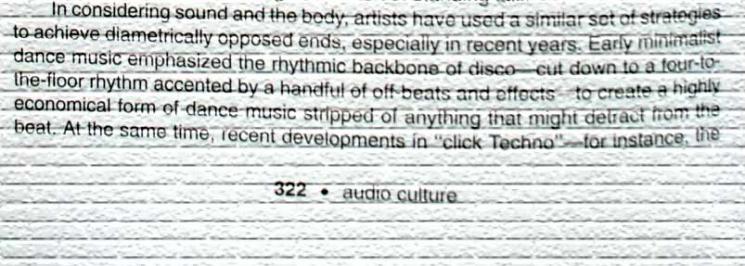
the profoundly thinned-out tracks highlighted on Mille Plateaux’s Clicks + Cuts compilations, or Jan Jelinek’s densely looped work as Farben, which he explicitly connects to the minimalist tradition via the moir=8E effects in Op Art – could hardly be classified as club music, lacking the forceful rhythmic intensity required to sustain a dance floor. If anything, the latter exists as music in reaction to the dance club, an avant-gardist rejection of the obviousness that characterizes most populist dance music.
In minimalism’s ubiquity, then, its strategies have turned out to offer solutions to varying, even opposed, sets of problems. If one thing remains constant, though, it’s the emphasis on time – by cutting out pop music’s chord progressions and four-bar structure, and emphasizing gradually evolving rhythmic cycles,
It’s worth asking why non-club-oriented productions have retained this focus. The ideology of the nightclub, of course, is that “the party never ends.” This is preserved by seamlessly sequencing multiple DJs across the course of the evening who will typically play within well-defined stylistic and tempo parameters; it’s augmented by the use of drugs like Ecstasy to help keep partiers going long after normal bedtimes.
It’s possible that this represents a resurgence of the Modernist ideal of pure formalism – related, of course, to classical Minimalism’s exploration in the acoustic and psychological properties of repetition. Just as Picasso could exhibit the African mask divorced from its social context as an example of “pure” geometry, domestic techno seems to pursue ever more specific lines of inquiry into the function of
Published in Christoph Cox and Daniel Warner, Audio Culture: Readings In Modern Music, 2004
techno’s origins are best documented in Xeroxed fanzines which were seldom archived, making any definitive research difficult. As early as 1992, though, Simon Reynolds was referring to the work of Detroit techno pioneers like Derrick May as “elegantly minimalist,” in contrast to the rough-and-tumble productions of the UK’s breakbeat ‘ardkore movement. 1 Also in 1992, a user on the rec.music.reviews newsgroup, archived by Google, can be found referring to “minimal bleep style,” and by 1993 a poster to the alt.rave newsgroup, attempting to make some sense of electronic dance music’s proliferation of subgenres, uses “minimal techno” to describe the work of both Detroit’s Carl Craig and Finland’s S=8Akh=9A label.
found everywhere from projects like Minimal Man to labels like the economically titled Minimal Records. Minimalism has become so entrenched that it’s invoked reflexively, if erroneously: Germany’s Areal label, which more than any other techno imprint is pioneering a fattened-up return to song-form, albeit within the context of repetitive dance floor tracks, goes by the motto, “Advanced Tech-Electronic Minimalism.”
Robert Hood – The Pace (from Minimal Nation EP) (more…)
Posted in academia on October 4th, 2008 by fresh good minimal |
3 Comments
Published in Christoph Cox and Daniel Warner, Audio Culture: Readings In Modern Music, 2004
Like some microbiotic virus, minimalism is everywhere these days. In popular culture and the lifestyle press, it may not have the same cachet it did in the sans-serif ’90s, but from the radio dial to the galleries to underground nightclubs, sonic minimalism is on the upsurge. It’s especially prominent in the various forms of electronic dance music – techno, house – and their “post-techno” offshoots. To paraphrase New Order, the 80s group who themselves thinned pop music down to its lithe, arpeggiated essence, everything’s gone lean.
This, in itself, is not news. The origins of most contemporary electronic dance music — found in Kraftwerk’s 1974 opus “Autobahn” and updated in the late ’80s and early ’90s with the streamlined electronic funk of Detroit techno pioneers like Derrick May and Juan Atkins — emphasized a pared-down palette that cut away all the excesses of a bloating rock and pop tradition.
Since then, much dance-floor fare has restrained itself to a limited set of sounds and has produced forms heavily reliant on loops, recurring sequences, and accumulation-through-repetition. These are key tropes in much pop music, but electronic dance music particularly foregrounds the strategies pioneered in the work of so-called Minimalist composers like Steve Reich and Philip Glass. Indeed, while it’s possible to say that most electronic dance music would be impossible without an emphasis on repetition, beat-oriented electronic music’s most avant-garde productions explore the very nature of repetition itself, carrying on the mantle of classical Minimalism as a movement delving deep into the heart of form – or, perhaps, skittering across its slick surface.
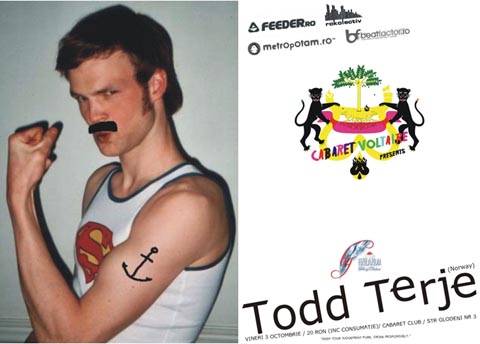
“Yes yes oh yey! Norway’s very own Todd Terje, the third component of the holy triumvirate of space-disco (the other two being Prins Thomas and Lindstrom) will be spinning in Bucharest”
si un kent private party cu Juan Atkins si Kenny Larkin la Martin (la tavan), sambata
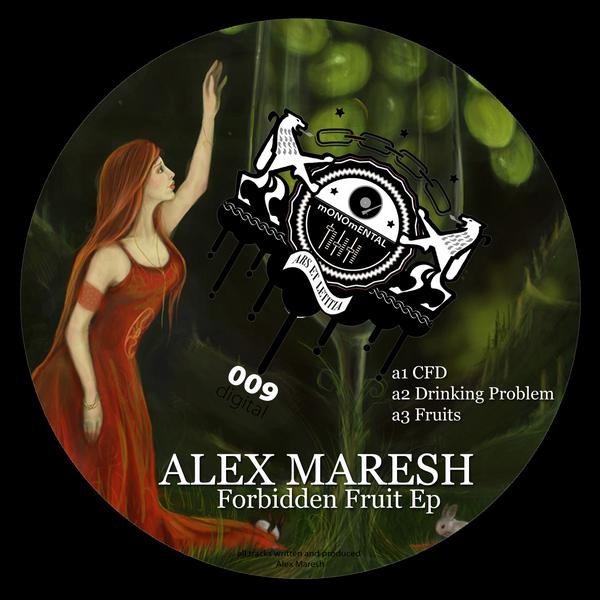
Buzz.ro de la Maresh, care a scos de curand un nou EP, la lebelul nemtesc mONOmENTAL, axat pe minimal techno.
text by Maresh
Piesa se numeste asa din cauza unei erori la randare. Nu stiu din ce motiv s-a salvat cu numele asta, si asa i-a ramas, AMIN! Fiecare intelege ce vrea atat din piesa cat si din nume. Mie unu mi se pare cea mai reusita piesa de pe EP, un pic mai subtila dar cu o percutie sanatoasa. Techno all over!
Alex Maresh – CFD
E o mica poveste … a mea, a ta, a AA-lor. De fapt descrie foarte bine anumite seri de “citirica” pe care cu siguranta cu totii le mai petrecem ba la unu ba pe la altul pe acasa. De fapt, piesa a prins contur intr-o seara de genu asta … PAM .. PAM !
Alex Maresh – Drinking Problem
Piesa de la numele careia a pornit si numele EPului, dar nu stiu de ce … Piesa este total destinata ringului de dans. Nu e nimic de inteles din ea, doar de dansat. Mi se pare ca e super groovy.
Alex Maresh – Fruits
Posted in buzz.RO on October 3rd, 2008 by fresh good minimal |
0 Comments
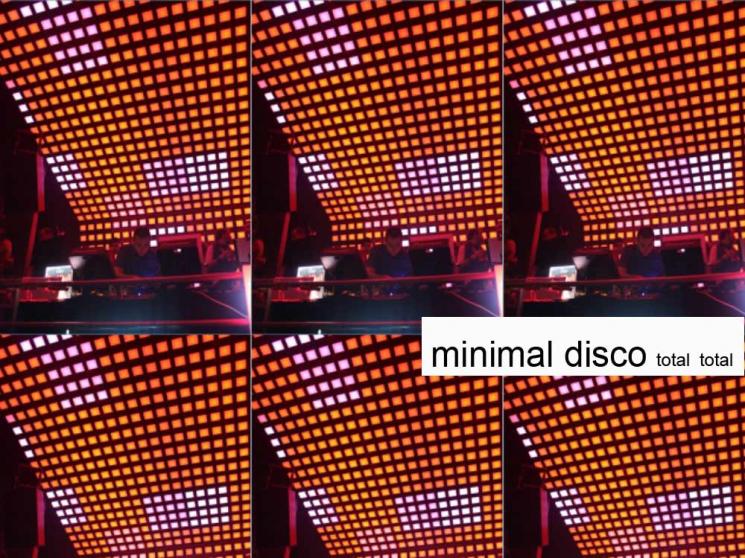
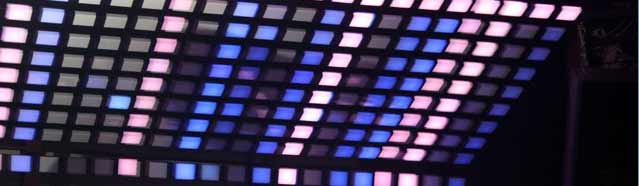
Sambata noaptea, imediat dupa miezul notii, in fata la Martin un pokemon se pozeaza la zid in lumina reflectoarelor, adica a taxiului si a puhoiului de masini din care iese lume, lume; multa lume la Martin. A venit toamna, a inceput sezonul. Noul tavan este in primul rand “antiglam”, dupa care e “tare”, “super bine”, “face tot”. “Bine ca am scapat de disco-ball-ul ala”, “cat costa instalatia asta? Vreau la mine-n dormitor”, “m-am gandit toata noaptea cate poti sa faci cu tavanul asta”, “tavanul asta…cate patratele are?”, “bai cred ca….” si numara, “pe latime aproximativ 30…”, si numara, “pe lungime 70”, peste 2000 de patratele in…”, si calculeaza, “toate foarte multe culori”. Fara a pune la socoteala si ecranul din spatele DJ-ului. Deci, cum sta treaba cu tavanul la Martin? E minimal disco total.
Pupitrul pare mai sus, te atinge la suflet, remember the old good vibe, spatiul din spatele DJului mai mic, drept urmare si mai putina lume, dar sunt toti mai fericiti, caci se vad mai bine. Ai lumina sa scrii. Iata emo veseli. Muzica e foarte buna. Pune Imek minimale, se danseaza, se tipa, nu se danseaza, se fluiera, maini in aer sunt mereu. Woaa, ce vibe! Un party people iti spune la ureche ca muzica este “cocalareala”. Tie iti place. Iti place cocalareala. Este foarte dansanta. Ba chiar piesa asta e un minimal techno care te face sa razi, uite-te la tine, uite-te la ceilalti, se infrupta din fiecare riff ca din roadele toamnei.
Party people a plecat. Asta inseamna ca e din ce in ce mai bine. Vine si de-dans la tine, e o piesa pentru el: “parca zice ta na, de dans, tana, de dans”, si-ti place sa crezi ca e asa, ca sa va radeti si mai mult. Se pune techno, toti danseaza fericiti cu pumnul in aer, luminile o iau razna, se tipa, nu stii, e muzica, e lumea, toate sunt una. Le-a pus stapanire pe creier, toti dau din picioare, ca-ti vine sa-i intrebi, incotro? Muzica din categoria minimal tune oricand. Lume buna si da, si niste pokemoni care desfac borcane dansand, cu capul pe spate. Daca acum e asa, Alex Under oare ce-o sa faca?
Toata lumea e pe ring, la toaleta la Martin nu este coada. De sus, tavanul este “coplesitor”, “atat de aproape”, “ai o viziune completa asupra problemei”, “o sa cada balconul?”, se aude techno melodic care te scote din minti. A intrat Alex Under. Mixeaza relaxat, cu tigarea in gura, in timp ce altii isi pun problema daca ii tine balconul. Cu greu gasesti loc langa balustrada, pentru panorama, asa ca te duci fix in fata, fix in mijloc, exact cand arunca cu niste techno cu voci din cocotier. Pe asta nu prea iti vine sa dansezi, te simti ca o maimuta. Putin mai tarziu se chiuie, se aplauda si se fluiera, te simti asa scurt, ca la nunta. O fata sta plictisita pe o canapea, un baiat seamana cu Alex Under. DJ-ul este dur. Foarte dur. Atat de dur. Te duci acasa. Sa tot fie Martin in octombrie.

















 gmail
gmail com
com